Transparent LED screens represent an expanding market segment, and it is totally understandable why. Retail brands, real estate showrooms, airports, corporate offices, and many more are all leveraging this technology to produce eye-catching visuals without completely shutting out the natural light or the views. Still, talking of transparent LED screen manufacturers, the reality is that they do not all produce the same level of quality, reliability, or the kind of service they offer. For example, some suppliers might lower the transparency rates to cut costs, while others might promise too much brightness and then deliver very little when tested in real conditions.
How to choose the right manufacturer for your project, then? This comprehensive guide is your playbook for inspection, evaluation, and ultimately, signing a deal with a supplier that is perfect for your needs.
Why Choosing the Right Manufacturer Matters
Transparent LED screens are not just simple products. They are a complicated blend of optical engineering, structural design, and very advanced electronics. Besides just a poor appearance, a badly made product is also going to cause you problems for a long time and will be expensive to maintain
The right transparent LED display supplier gives you:
- Products that always perform the same throughout years of usage
- Help desk for any technical-related problems
- Options to customize based on your needs
- Reasonable prices with no hidden charges
Let’s explore what makes one manufacturer a really good one while others remain average.
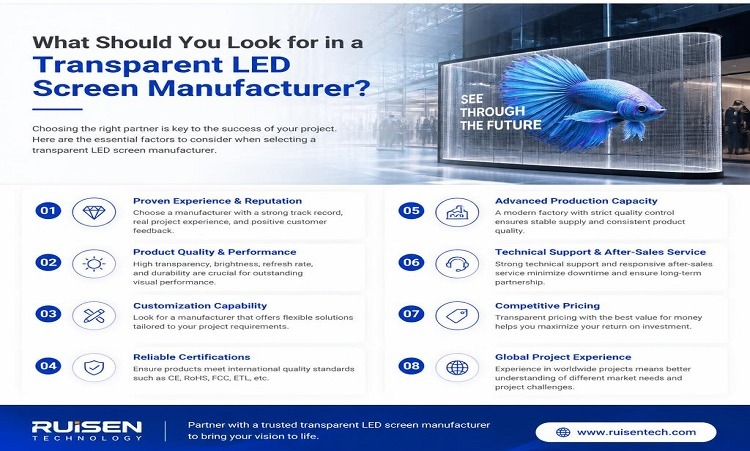
Key Factors to Evaluate in a Transparent LED Screen Manufacturer
1. Transparency Rate and Optical Clarity
The most visible sign of a see-through LED display is its level of transparency. A reliable manufacturer should offer transparency rates ranging from 70% to 95%, though the actual rate achieved will depend on pixel pitch — lower pixel pitches typically yield 50–70% transparency, while higher pitches such as P10 can reach up to 90–95% with trade-offs in image resolution.
Do not take at face value the transparency rate offered by your supplier just based on marketing. You should rather look for actual light transmittance figures that are gotten from standardized testing. Low optical clarity means that the main purpose of the transparent display will be defeated.
2. Pixel Pitch and Display Quality
Pixel pitch is one of the main factors behind image sharpness and determines at what distance from the display the viewer can still enjoy a natural picture without seeing individual dots. A reputable transparent LED display manufacturer will typically offer pixel pitches ranging from P3.91 to P10 across their product range.
Looking up a suitable pixel pitch can be an easy task if you follow the guide below:
| Pixel Pitch | Best Viewing Distance | Common Use Case |
| P3.91 – P5 | 2 – 5 meters | Retail stores, showrooms |
| P5 – P7.8 | 5 – 10 meters | Shopping malls, lobbies |
| P7.8 – P10 | 10+ meters | Building facades, airports |
3. Brightness Levels and Ambient Light Performance
Most transparent LED displays are placed in areas that receive a lot of natural light, such as shop windows, glass walls, and terminals of airports. If the brightness is low, the display will not only suffer from glare and will even become invisible generally during the daytime.
For outdoor-facing transparent LED applications, look for manufacturers who can provide brightness levels of at least 3,500 to 6,000 nits — though note that due to the inherent gaps in transparent LED strips, effective perceived brightness will be lower than these peak specifications. For indoor use, 1,500 to 2,500 nits is generally appropriate. In case of indoors, 1,500 to 2,500 nits is usually the level of brightness that suits the needs.
4. Build Quality and IP Rating
The physical construction of LED parts like display modules and cabinets and the way these are connected is a great indicator of the manufacturer’s ethos. So inspect the following:
- Cabinet material — aluminum alloy is preferred for strength and heat dissipation
- IP rating — IP65 is the minimum standard for outdoor or semi-outdoor use; coastal or high-rainfall environments may require IP66 or higher
- PCB quality — look for gold or tin-plated boards for corrosion resistance
- Heat management — passive or active cooling systems to prevent overheating
Choosing a manufacturer that cuts corners on build quality will end up costing you much more in maintenance and replacing parts over the years.
5. Customization Possibilities
Each transparent LED display project is different. A dependable manufacturer should be capable of customizing this:
- Size and shape of the display (curved, flat, irregular)
- Pixel pitch and cabinet depth based on the location requirements
- Mounting methods for standing on the floor, hanging from the ceiling, or integrated into the wall
- Control systems that work with your current AV infrastructure
In case a vendor only brings standard pre-made sizes, they might not be suitable for complex or large-scale projects.
6. Manufacturing Certifications and Compliance
Safety and quality certificates are more than just documents; they demonstrate that the product has undergone independent testing and satisfies the global standards for safety and quality. You should at least check for:
- CE marking (mandatory for European markets)
- FCC marking (mandatory for the American market)
- RoHS compliance (limit of hazardous substances)
- ISO 9001 quality management system certification
When a transparent LED film screen manufacturer is certified, they can guarantee the quality of their products. Besides that, it is also really easier to handle procurement when confronting regulatory requirements in your country.
7. After-Sales Service and Warranty
LED screens are a major part of your business’s visual branding. Sometimes, a driver IC may be faulty, a display unit may show dead pixels, or a main board may need to be replaced. What happens next is entirely dependent on the manufacturer’s after-sales support system.
You should consider these:
- What length of warranty coverage is provided? (2 to 3 years is common among established manufacturers, though this varies — always verify terms in writing.)
- Can spare parts be obtained quickly?
- Is technical support available remotely or on-site?
- How long does it take, on average, to get a response from support?
Poor after-sales support is a major source of customer dissatisfaction when it comes to LED screen suppliers. So, make sure you consider this aspect as well.
8. Production Ability and Lead Time
In case you are rolling out a large retail chain or running a nationwide advertising campaign, you want a manufacturer who is able to supply at a large scale and timely. Inquire about:
- Can production be ramped up quickly to meet monthly demand?
- How long is the usual lead time for customized orders?
- At what stages during the mass production cycle are quality controls carried out?
- What are the packaging and shipping arrangements for export?
Working with a manufacturer whose factory is well managed and who produces consistently high-quality goods will help minimize project delays as well as budget exceedances.
9. References and Track Record
The most qualified LED window display manufacturers will have a collection of real-life projects that they are excited to share with you. Request for:
- Project examples from industries or types of projects similar to yours
- Current clients’ contact information for references
- Pictures or movies of finished installations
You’re not only doing due diligence here; it’s also a way to see if the manufacturer has been able to deal with the kinds of issues that your project may face.
Quick Comparison: What Strong vs. Weak Manufacturers Offer
| Evaluation Area | Strong Manufacturer | Weak Manufacturer |
| Transparency Rate | Verified 70%–95% with test data | Vague claims, no test documentation |
| Pixel Pitch Options | Wide range, P3.91 to P10+ | Limited SKUs only |
| Certifications | CE, FCC, RoHS, ISO 9001 | No certifications or outdated ones |
| Customization | Full custom options available | Standard sizes only |
| After-Sales Support | Dedicated team, spare parts stocked | Slow response, limited spares |
| Warranty | 2–3 years with clear terms | Short or unclear warranty policy |
Red Flags to Watch Out For
Unfortunately, not all manufacturers will be honest about their limitations, so you should be careful about some red flags that the manufacturer might be hiding:
- A surprisingly low price could mean that the product components have been compromised in the manufacturing process
- Lack of factory audit option trustworthy manufacturers will allow factory visits and third-party audits
- Non-specific product details without the support of technical datasheets
- No customer references or only anonymous testimonials
- Using pressure tactics to get the deal closed quickly when the customer has not been given sufficient time for evaluating the product
Clearly if a supplier displays any of these mentioned qualities, it is wise to take the foot off the gas and do some further research.
Conclusion
Choosing the perfect transparent LED screen manufacturer needs time for reflection and cannot be a snap decision. The supplier you choose will largely determine the quality of your display, the level of installation efficiency, reliability, and ongoing maintenance costs. Taking a close look at different transparency levels, product certification, customization capabilities, and the manufacturer’s technical expertise will go a long way to help you avoid issues that could cost you a lot later on.
Besides the latest LED technology, a reliable manufacturer will give you professional advice, reliable service, and a responsive after-sales team. A transparent LED display is a visual representation of your brand and should be equally impactful and functional over the long term, whether in a retail environment or an architectural project.
Ruishen Technology is a manufacturer of transparent LED display products of very high quality for commercial and architectural applications. Get in touch with us to discuss your project and get a tailored solution that is perfectly aligned with your goals.
FAQs
What is the typical transparency rate for a transparent LED screen?
Usually, transparent LED screens can achieve around 70%–95% transparency, which means they can allow people to see through them and permit natural lighting at the same time they can put on a great visual display.
How long do transparent LED displays typically last?
Top-quality transparent LED displays typically last between 80,000 and 100,000 hours and usually come with 2-3-year warranties from the manufacturers.
Can transparent LED screens be used outdoors?
Yes, models for use outdoors are also manufactured; they come with IP65-rated protection and have high brightness levels so that it is easy to see the screen even in direct sunlight.
What industries use transparent LED displays the most?
Transparent LED displays have become a very popular feature in retail stores, malls, airports, showrooms, corporate spaces, museums, and live event venues.