Advertising has evolved over the last decade in many ways. Brands are continually seeking new methods to connect with their customers. One of the largest changes? The rise of DOOH screens.
But there’s the million-dollar question on everyone’s mind in marketing and procurement: How does a DOOH screen compare to traditional advertising?
Whether you’re considering a static billboard, print advertising, or an outdoor digital signage display, that’s all covered in this guide. No fluff. Simple and straightforward advice.
What Is a DOOH Screen?
DOOH stands for Digital Out-of-Home. A DOOH screen is a digital display that is located in public places, such as shopping malls, transit stations, airports, roadside billboards, and high-traffic urban areas.
A DOOH screen displays dynamic content, as opposed to a static billboard. That means videos, animations, live data feeds, and real-time information updates.
Programmatic DOOH goes one step further. It enables brands to automatically purchase and display ads based on time of day, weather, footfall, and audience demographics. It’s smart advertising for a smart world.
Traditional Advertising: Still Relevant?
Traditional advertising includes print ads, static billboards, posters, flyers, and newspaper advertising. These formats have been in use for years — for a reason.
They’re simple. They operate in areas with poor Internet connections. And they carry a familiar, tangible presence that some audiences still respond to.
But here’s the challenge: Traditional advertising is rigid. Once printed, you can’t change it. You pay and pray, and you hope the message got through, but you don’t know.
DOOH Screen vs Traditional Advertising: Head-to-Head Comparison
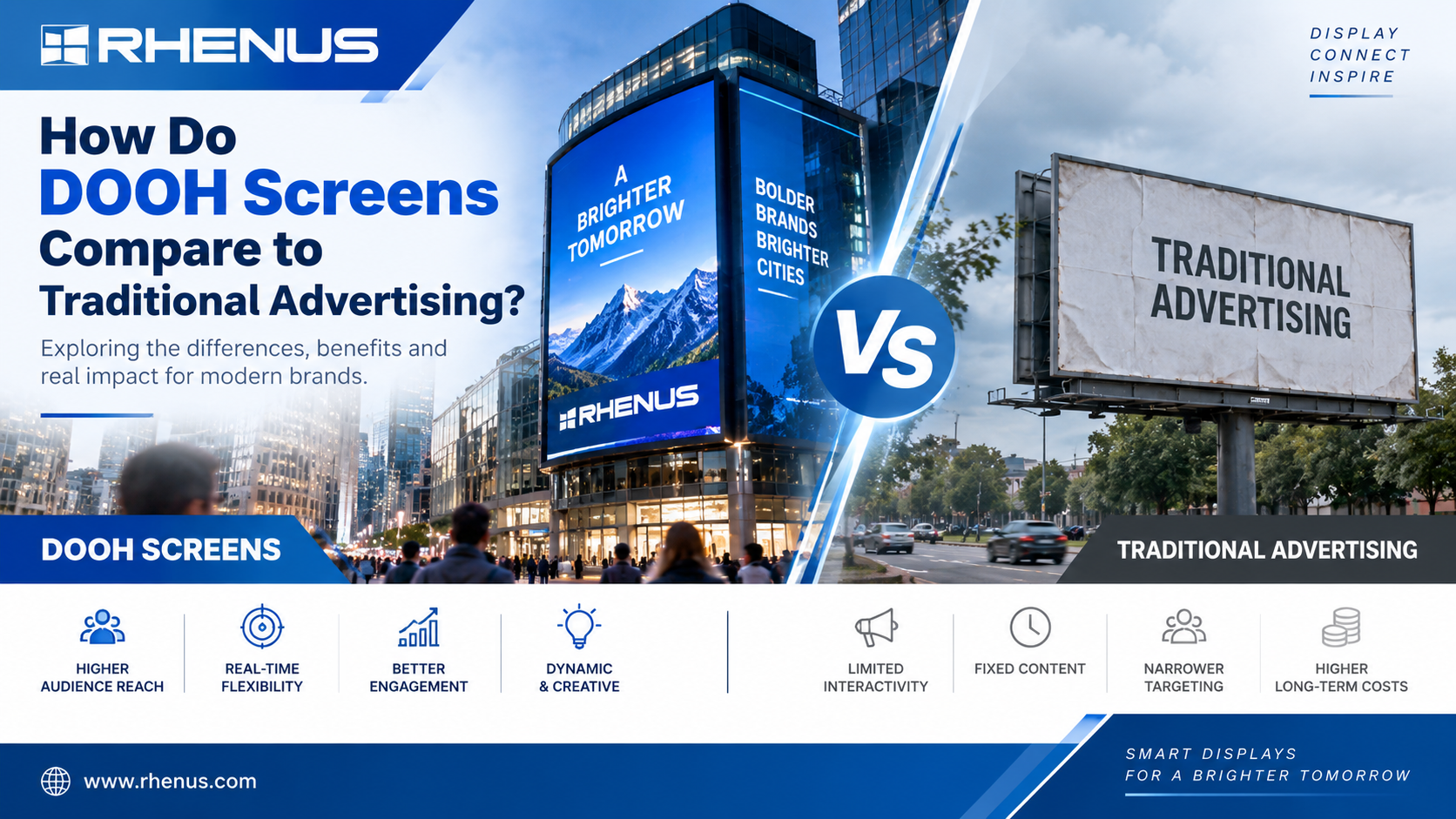
So let’s take a quick look at the comparison. Let’s compare a DOOH screen to traditional advertising in the most impactful areas:
| Feature | DOOH Screen | Traditional Advertising |
| Content Updates | Real-time, instant changes | Requires reprinting/redesign |
| Targeting | Location & time-based | Fixed, broad audience |
| Interactivity | Dynamic, interactive content | Static only |
| Analytics | Real-time performance data | Limited/delayed metrics |
| Cost Over Time | Lower long-term cost | Recurring print/placement costs |
| Environmental Impact | Paperless, eco-friendly | Generates print waste |
| Audience Reach | High-traffic public locations | Limited to placement area |
Key Advantages of Using a DOOH Screen
1. Real-Time Content Flexibility
A DOOH screen allows you to change ad content in real-time. Starting a flash sale? Responding to a news event? New creatives can be pushed in minutes and not days.
Traditional advertising locks you in. If you change your offer, you reprint, rebook, and spend again.
2. Better Audience Targeting
By using outdoor digital signage, you can target by:
- Audience geolocation and proximity to your store.
- Weather conditions (e.g., promoting hot coffee on cold days or cold drinks in hot weather).
- Weather conditions (encourage hot coffee on cold days)
- The audience demographics and footfall data.
Traditional billboard advertising doesn’t provide any of this. Your ad is displayed to all—regardless of whether they are relevant or not.
3. Higher Engagement and Recall
Movement and visual movement are sure to capture attention. Research indicates that digital display ads are much more likely to be recalled than static ads.
A plaza-style DOOH display that’s situated in a highly populated transit area can impact thousands of commuters every day with content that will truly get noticed.
4. Stronger ROI Over Time
Traditional advertising involves recurring expenses like printing, hanging, and replacing the ads every few weeks. The better ROI of DOOH is as you continue to use the same screen infrastructure for more campaigns.
The first investment is worth it because there are no continuous production costs. Content is digital, and so is it reusable.
5. Measurable, Data-Driven Results
This is where all the traditional ad methods fall behind digital out-of-home advertising. You can enjoy smart advertising screens, which give you:
- Real-time impressions and play counts.
- Using the built-in sensors, the audience is analyzed.
- Campaign performance dashboards
A/B testing not only for different creatives but also multiple creatives.
Traditional billboard advertising? You get estimated traffic data — and that’s about it.
Where Does Traditional Advertising Still Win?
Fairness matters. In some instances traditional formats are still relevant:
- Rural or low-infrastructure areas where digital networks are not available.
- Super high production quality standards with or without strict budgets
- Hyper-local campaigns that target a single, specific neighborhood
- 4. Some audiences that are more receptive to print (e.g., older audiences)
- But for most B2B and B2C advertising decisions — especially in urban environments and retail corridors — the DOOH screen is the smarter long-term choice.
Industries Benefiting Most from DOOH Screens
There have been several high-growth industries where DOOH screens are becoming the preferred format:
- Retail & Shopping Centers – drive deals directly to shoppers in-store or nearby
- Transportation Hubs – Airports and metro stations see massive daily audiences
- Wayfinding and promotions screens are used in hospitals, stadiums, and convention centers.
- Healthcare – Patient communication, brand building for Clinics and Hospitals
- Real Estate & Finance – Messaging that is time-sensitive and responds to the market changes.
Conclusion
Dynamic content, real-time updates, and enhanced audience engagement are reshaping outdoor advertising with DOOH screens. They can be used to deliver flexible, impactful campaigns in high-traffic locations, unlike traditional billboards.
The advertising tools that are present in the modern businesses must be able to adjust to the different changes that are taking place in the market. With its ability to be targeted intelligently, measurable, and cost-effective over time, DOOH advertising is a powerful solution for achieving scalable brand visibility.
If your business wants to improve its outdoor digital signage solution, Shenzhen Ruishen Optoelectronics Technology Co., Ltd. offers you a reliable and high-performance solution. These are advanced displays that are meant to fully be seen, engaged, and advertised.
FAQs
What is the main difference between DOOH and traditional outdoor advertising?
Traditional advertising with static printed billboards is a thing of the past, whereas DOOH is based on digital screens where the content is updated in real-time.
Is DOOH advertising more expensive than traditional billboard advertising?
While initial setup costs can be a bit more expensive, DOOH can lower the amount of time and money spent on printing and installation in the long run, thereby enhancing ROI.
How does programmatic DOOH work?
Programmatic DOOH is the use of data and automation to create contextual, timely, location- and audience-specific advertising.
Can small businesses benefit from DOOH screen advertising?
Yes. Small businesses can afford and benefit from DOOH advertising due to flexible budgets and short campaigns.