You can spend weeks reviewing panel specs and still pick the wrong partner. The LED display market is filled with companies that claim to be manufacturers online but in reality are trading companies, with no factory, no engineers, and no responsibility for any problems that may occur after installation. There are lots of businesses that just look at the pricing when choosing an LED display manufacturer, and then the difference comes after installation. Low brightness, dead pixels, poor support, and frequent downtime quickly turn a cheap deal into an expensive problem. Choosing the right LED display manufacturer is not just a procurement decision. It is a risk management decision. Before making a final decision, here are the most important factors every buyer should evaluate.
1. Confirm That They Actually Manufacture
Before anything else, verify that the company controls its own production. First of all, check whether the company is self-producing. A true LED display manufacturer possesses their own SMT lines, PCB production lines, and module assembly lines and does not rely on outsourcing them. Ask for a factory audit or live video walkthrough. If they don’t respond to that request, it’s a clear warning sign.
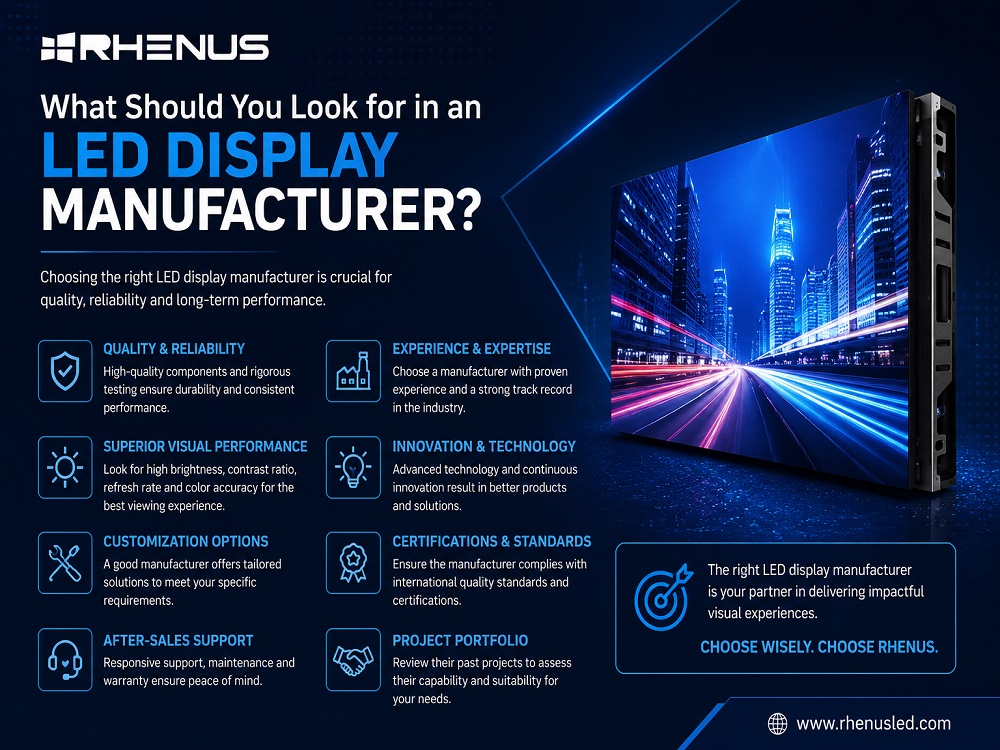
2. Product Quality and Display Performance
Real quality is measurable! Look for panels with a refresh rate of 3,840Hz or higher for flicker-free performance under cameras. Review brightness numbers based on settings; outside lighting may need 5,000 nits or higher. Check for any color consistency over large orders and if panels are tested in matched batches. If a manufacturer refuses to give you specific information about its products, that hesitation itself should be treated as a warning sign.
Key quality indicators to request:
- Refresh rate and grayscale specs
- Brightness ratings according to product lines
- Batch color and brightness uniformity test results
- Failure rate limits accepted prior to shipment (Pixel failure rates)
3. Manufacturing Standards and Certifications
All suppliers have certifications on their website. Most buyers never verify them. A reputable LED display company should have at least the CE, RoHS, FCC and ISO 9001 certifications (all of which can be checked). CE and UL have online searchable databases. Request the actual certificate number, not a copy of the brochure, and verify it yourself. A certification that has expired or is for a different product is better to be discovered before than after signing a contract.
4. Customization Capabilities
Standard catalog products work for standard projects. Most commercial B2B deployments, from retail stores to transit hubs, corporate lobbies and arenas, have needs that off-the-shelf configurations do not address. A capable LED display manufacturer should clearly offer OEM and ODM services. “OEM” refers to the manufacturing of products under your brand. The advantage of ODM is that their engineers can redesign their components as per your project requirements. If a supplier of LED displays cannot guide you through the procedure of how their R&D team deals with non-standard requirements, then it is a practical no.
5. Technical Support and After-Sales Service
LED displays are used 24 hrs a day in challenging environments. Modules fail, firmware must be updated, and calibration changes over the years. It’s not about the manufacturer being available during the sales process – it’s about being available when that’s necessary. The standard B2B response time is 24 to 48 hours. Ensure that spare parts are available for not less than five years after purchase. Request references and talk with existing clients in person about their after-sale experience.
6. Production Capacity and Delivery Reliability
If you place large orders, your manufacturer’s output ceiling is as important as the quality of their product. If the facility is almost full, it will be less likely to handle your order when sales are high. Seek information on the production output per month, lead times for standard and custom orders, and on-time delivery rates on previous orders.
Delivery factors to confirm:
- Monthly production capacity
- Standard and Custom Order lead time
- Historical on-time delivery rate
- Policies for buffer stocks for ongoing projects
7. Real Client Experience and Industry Reputation
A marketing document’s aim is to impress. The real picture emerges in client references. Any LED display company you are considering should have a network of contacts who have experience in the same scale and type of projects that you are looking for. Repeat business from the same customers is a direct indication that a manufacturer meets what they promise.
8. Pricing Transparency and Long-Term Value
The cheapest option is rarely the smartest option. Over the five-year life cycle, hidden charges for engineering support, firmware updates, spare parts, shipping, etc., could make a significant difference in total cost of ownership. A reliable LED display company offers detailed estimates and outlines the terms. They can also offer you estimated maintenance costs and let you know the impact of the product lifespan and warranty terms on your investment.
Conclusion
The only way to make an accurate assessment of an LED display manufacturer is to look at their product catalog and request a quote. The eight factors presented here, from verified manufacturing to measurable quality to pricing transparency and real client references, provide a framework to make a sourcing decision that won’t lead to regrets two years into a project. If you are looking for a manufacturer that will meet all of these requirements, then make sure you are selecting Ruishen Technology. With a long history of international B2B experience and proven quality production, they possess an honest customization capability and the post-sale support that is essential for serious projects.
FAQs
How do I know if a company is a real manufacturer or just a reseller?
Ask for a factory audit or live video walkthrough. Genuine manufacturers can show SMT lines and QC zones. Resellers have nothing equivalent.
What certifications should a global LED display manufacturer carry?
CE, RoHS, FCC, and ISO 9001 are the standard baseline. Verify certificate numbers in public databases — logos on a brochure prove nothing.
What after-sales response time should I expect from an LED display supplier?
The accepted B2B benchmark is 24 to 48 hours. Anything slower puts project continuity at real risk.
Is the lowest quote always the best value?
No. Factor in warranty depth, spare part availability, and support quality. The cheapest panel often carries the highest total cost over five years.